
Jail Roster data for Greenville County is refreshed every few hours, giving families and attorneys near‑real‑time insight into who is housed at the downtown detention center. By entering a name, booking number, or inmate ID on the official Greenville County jail roster online, users can see custody status, bail amount, and facility assignment without leaving home. The portal also flags recently booked inmates, transfers, and releases, helping you stay informed when urgent decisions are needed.
Jail Roster access includes the Greenville County inmate list, booking timestamps, and offense charges, all displayed in a clear table that updates daily. If a record seems missing, the system notes typical delay periods for new intakes and explains the removal timeline for released individuals. For deeper verification, the Greenville County jail roster lookup by name or ID links to the county’s public inmate records, ensuring you can confirm identity and bond details quickly.
How to Search Jail Roster
The Jail Roster on Greenville County’s official site offers a near-current view of people held in the county’s downtown detention center. A search by name, booking number, or inmate ID can return booking details, listed charges, bond amount, custody status, and facility assignment. You can also access jail mugshots to review official records. These fields help families, attorneys, and other approved parties confirm a person’s detention status without relying on an arrest report alone. Since bookings, transfers, and releases can change the roster, treat each result as a dated status check and confirm time-sensitive decisions with the detention center.
Official Search Portal: https://greenvillecountysc.gov/disclaimer/InmateSearch.aspx
Steps to Search
- Open the Greenville County Inmate Search page. Read the disclaimer on the page before using any result, since a public roster has limits on age, timing, and record scope.
- Locate the fields for inmate name, booking number, and inmate ID. Use the field that matches the identifier you have rather than placing unrelated numbers into the same box.
- Enter the name exactly as it appears on the booking notice, court paper, or other county record. For a number search, copy every digit and remove spaces only if the page accepts that format.
- Submit the search and wait for the results table to load. A valid match may include the person’s name, booking date and time, listed charge, bond amount, custody status, and facility assignment.
- Compare each result with the identifiers you supplied. Check the spelling, booking number, and inmate ID together, since two people may share a name or have similar names.
- Read the roster’s date and status fields before drawing a conclusion. A recent booking may still be moving through the publication cycle, and a released person may remain in the table until the removal update finishes.
- Save a copy of the result when you need to refer to it later. Record the search date, the exact booking number, the listed status, and any visible facility assignment.
- Contact the county detention center through the details at the end of this page if a release, transfer, bond, or placement question depends on a same-day answer. A web result can be several hours behind the facility’s physical roster.
Choose the Strongest Search Identifier
A booking number or inmate ID gives the cleanest match because each points to a county record. A name works for a first search, yet spelling, aliases, and common names can produce extra rows. Use at least two matching fields before treating a result as confirmed.
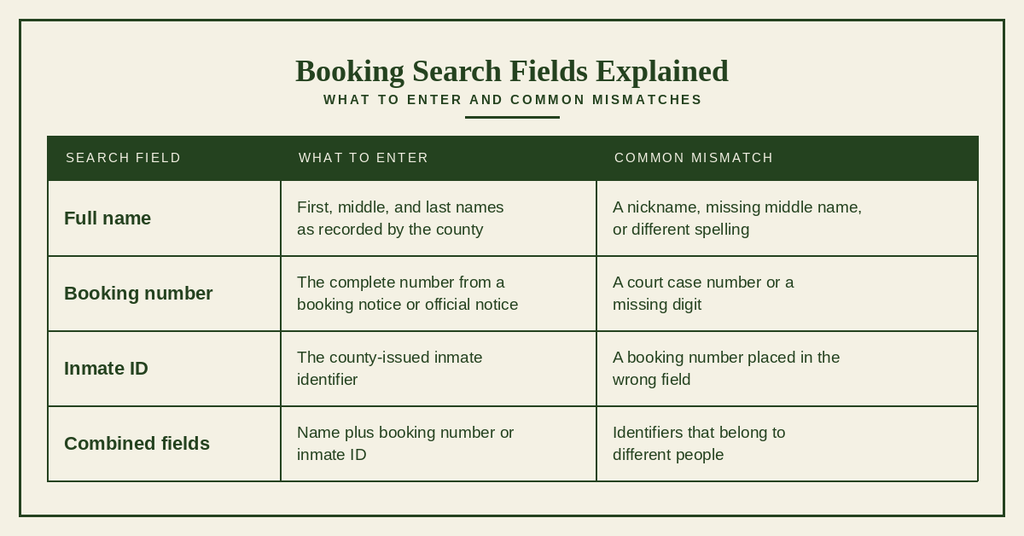
For an ambiguous name, compare the booking date, location, and charge with records held by the family, attorney, or court. A charge description can help separate two similar names, yet it does not establish guilt or the outcome of the case.
Intake Details and Custody Status
The roster centers on detention activity rather than the full history of a court case. Its records connect a person to an intake event, a listed charge, a bond figure, and a custody status at the time of the latest posted update. These fields answer practical questions about location and detention status, while court disposition and case merits remain with the courts.
Booking Timestamps, Agency, and Arrest Logs
A booking date and time mark the intake event recorded in the jail system. That moment may differ from the arrest time because an arrest can happen before transport, processing, and jail admission. The roster should be used for the county booking event, not as proof of the exact arrest time.
The agency connected with an arrest or booking may appear as a full name or code. If the online row does not provide enough detail, ask the detention center for the booking report tied to a specific number. Police agencies, the sheriff’s office, and the court can hold different parts of the case, so one source may not cover the entire event.
- Booking date and time place the intake within the detention timeline.
- Booking number identifies the intake event and helps connect separate requests.
- Booking agency identifies the agency connected with the intake when the county displays it.
- Arrest log details may come from the arresting agency rather than the jail’s public row.
- Incident details can differ across arrest, booking, and court records.
Offense Charges, Bail, and Bond Amounts
A listed charge describes the alleged offense connected to the booking. It does not establish that a crime occurred, that the person was convicted, or that a court has imposed a sentence. The case status must be checked through the court named in the legal papers.
Bail and bond fields show the amount recorded for the person at the time of the roster update. A bond amount does not show whether the money was posted, whether a judge changed the figure, or when release may occur. A listed $0 amount can also require confirmation, since it may reflect a current court status rather than a final decision about the case.
Charge wording can change as the case moves from arrest to booking and court review. For a legal decision, use the charging document and court docket rather than a shortened roster description.
Active Custody, Transfer, and Release Status
Custody status tells whether the county lists the person as held, released, transferred, or newly booked at the time of the update. The exact labels may vary, so read the wording and timestamp rather than assuming that every row uses the same term. Recent bookings, transfers, and releases can appear as separate entries or status changes.
An active-custody entry means the person was recorded as held during the latest posted cycle. It does not predict how long detention may last. Court dates, bond issues, medical matters, and scheduling decisions can change the actual release time.
A booked person has not necessarily been convicted. Likewise, a missing row does not prove that the person was never arrested. The person may not yet be booked, may be held elsewhere, or may fall outside the public roster’s scope.
Detention Center and Facility Assignments
A facility assignment shows where the county placed the person during the latest roster cycle. The downtown detention center may appear by name, while another entry may use a code or transfer notation. The field identifies the county’s placement, not the person’s exact room or daily movements inside the building.
The jail roster is not a complete facility record. It does not establish cell assignment, security class, medical condition, visitation status, or release time unless the county publishes a separate field for that subject. A person can also be transferred after the roster was posted, so a placement field needs a date beside it.
One filtered search should never be treated as the Greenville County jail population. Search filters, pagination, recent intake delays, and transfers affect the number of visible rows. Individuals can also check jail records to verify relevant details. Use a county-published population statement for a population total rather than counting one page of search results.
Public Availability and File Disclosure
The online Jail Roster is a limited public view of county detention records. It supports quick custody checks, yet it does not replace a complete booking report, police file, court docket, or certified document. Knowing which record type answers a question prevents one source from being used for a purpose it cannot serve.
Daily Online Roster Publishing Schedules
The official county page states that Jail Roster data is refreshed every few hours and describes the visible table as updating daily. Taken together, these statements point to a recurring refresh within a daily publication cycle. No fixed cutoff hour or minute is stated, so a search near the end of the day may differ from one made the next morning.
Think of each result as a near-current snapshot rather than a live tracking service. A booking can enter the jail system before it reaches the public table. A release can occur before the old row is removed. The page’s visible date and the time of your search should both be kept with any result that matters.
The official page states that data refreshes every few hours, so new bookings or status changes may appear after a delay. The visible roster may also follow a daily publication cycle without a fixed posting time. Recent booking, transfer, and release details can change between searches, so older results may no longer be current.
For a same-day legal or family decision, search once and then call the detention center if the result is unclear. Repeated searches within minutes may show the same posting cycle and will not remove a system delay.
Confidential Files and Juvenile Exclusions
Public roster rows and full case files cover different subjects. A detention row may show the basic intake facts, while police reports, witness details, sealed filings, and confidential juvenile records can remain with the agency or court that created them. South Carolina law also limits some juvenile disclosures.
South Carolina Code of Laws § 63-19-410 makes juvenile records confidential as a general rule and provides specific exceptions. This rule can explain why a full juvenile record is missing from an adult inmate roster. A parent, attorney, or other authorized party should use the juvenile court or agency process for that record.
Record Types and Where to Find Them
Inmate details, including names, booking numbers, charges, bond, and status, may appear in the Greenville County inmate search portal. Booking reports are available through the detention center records custodian, while police arrest reports must be requested from the responsible law enforcement agency. Mugshots may appear with booking records. Juvenile records are generally confidential, and sealed court files require contacting the appropriate court or agency.
A mugshot is a visual record tied to a booking, not proof of current custody. An older photo can remain on a third-party site after release or transfer. Match the image to a current booking number and use the county page for the most recent status shown there.
Arrest records and jail records also cover different events. A person can be arrested without being booked, booked and later released, or have an arrest file that continues after the jail record closes. Comparing dates and identifiers across the two types prevents a false match.
Off-line Record Requests and Verification
Use the county contact listed at the end of this page when the online roster cannot answer the question. Ask for the exact record type needed, such as detention-status confirmation, a booking report, or a custody-history record. This gives the records custodian a clear task and reduces confusion between arrest, jail, and court files.
Keep a written record request narrow. A precise booking number and date can locate the correct file faster than a name that matches several people. If a request involves a minor, sealed matter, or legal representation, ask the county which authorization is needed before sending documents.
- Call the county detention center and ask which office handles the requested record type.
- State the person’s full name, booking number or inmate ID, booking date, and the date range needed.
- Name the record requested. A current-custody confirmation and a complete booking report are not the same request.
- Ask about the accepted submission method, required identification, fee, processing time, and certified-copy rules. The listed county contact details do not state these request terms.
- Keep a confirmation number, receipt, or written note showing the date and scope of the request.
Do not send sensitive family or identity documents based on an unverified address found in an old message. Call first and confirm the correct office and submission method. If the matter is tied to a court deadline, tell the attorney or requesting office about that date.
Record Accuracy and Resolution
Roster errors can take several forms: a new booking may be missing, a released person may remain visible, a transferred person may no longer appear at the downtown center, or two similar names may be confused. A careful search depends on exact identifiers, source dates, and an understanding of how each record type changes.
System Delays for Recent Intakes
Recent bookings may take time to appear in the public roster because arrest, transportation, processing, and data entry must be completed first. Delays or corrections can cause the online portal to show information later than the facility’s internal records.
The county roster may refresh every few hours, but publication times can vary. If no entry appears after an arrest, try searching again later using the person’s name or booking number. For missing details, similar names, or questions about current custody status, contact the county facility or court for confirmation.
For a missed booking tied to a legal deadline, contact the detention center and the attorney handling the case. You can also consult police records to locate official filings. Give exact identifiers rather than a general description. This allows staff to check both the internal booking system and the next public roster update.
Post-Release Listing Removal Timelines
A release can occur before the old roster row disappears. The public table may still carry a prior status, or the removal update may wait for the next cycle. This creates a temporary conflict between the website and the person’s actual location. It does not mean the old row is a reliable statement of current custody.
No exact post-release removal interval is stated on the official page. Compare the row’s status, search date, and booking number, then check again after the next refresh. If the row still shows the person as held, contact the facility and request current-custody verification.
- Confirm that the row belongs to the correct person by booking number and inmate ID.
- Open the result again after the next posted update and record the new search time.
- Ask whether the person was released, transferred, or booked into another facility.
- Report a persistent listing that still shows active custody, including a screenshot and search date.
- Keep the county response with other case records so later requests use the correct booking number.
A stale row should not be treated as proof that the person remains confined. Its removal should not be treated as proof of a lawful release without official confirmation. Both statements require a dated check from the agency holding the record.
System Delays for Recent Intakes
A recent intake may pass through several steps before an entry appears in the public roster. The person must first be arrested, transported, processed, and booked. Staff then enter or update the county custody record before it becomes available through the next publication cycle. Delays at any stage can cause the online portal to lag behind the information held at the facility.
The county’s public information indicates that the roster refreshes every few hours, but this does not guarantee a fixed publication time for every new booking. Name-entry errors, incomplete information, or corrections made after booking can cause additional delays. Therefore, the absence of an entry shortly after an arrest does not necessarily mean that a record has been missed.
If no entry appears after a recent arrest, the person may not have completed the booking process, or the latest publication cycle may not have occurred. Try searching again after the next refresh and use the booking number if available. If no result appears after a court date, the person may not be held in county detention, so contact the court or county facility to verify custody status.
When several similar names appear, compare the inmate identification number or booking number to identify the correct entry. If a record lacks expected details, some fields may not yet be available or may appear only in the full booking report. Requesting the report using the booking number can help clarify the missing information.
Jail Roster and Related Record Types
Search results can contain similar names for different records. Knowing the owner and purpose of each record prevents a booking entry from being mistaken for a complete case history.
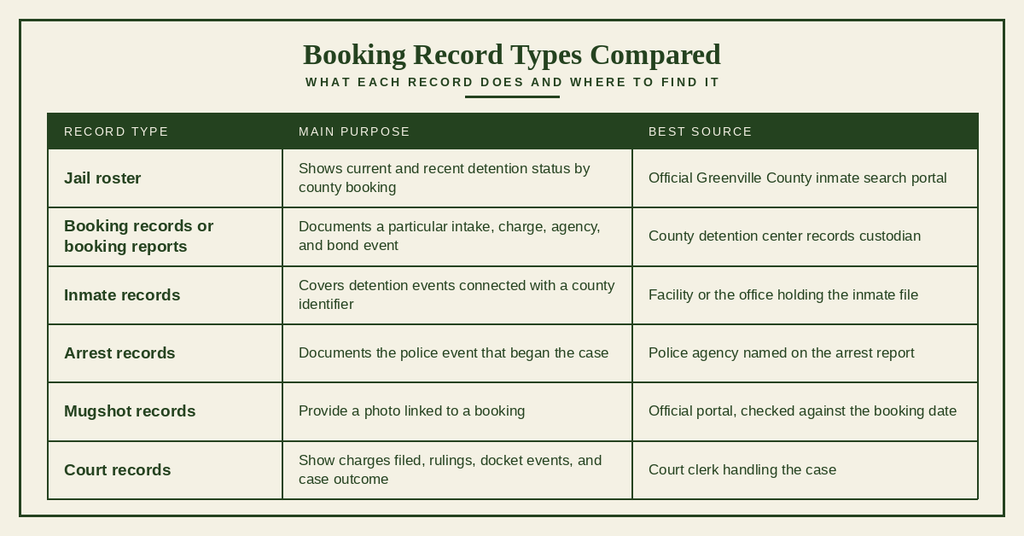
An arrest record can exist without a jail booking. A jail booking can exist without a conviction. A court case can continue after release. Use each source for the event it records, then connect the sources through verified identifiers.
Correcting a Roster Error
A correction request should identify the exact row and the exact conflict. State what the portal displayed, when it was viewed, and which official source gives a different fact. This format lets county staff compare records without guessing which field or person the request concerns.
- Save the page address, search date, search time, and a screenshot of the row.
- Copy the name, booking number, inmate ID, status, facility, and bond fields exactly as shown.
- Compare the row with the booking report, court papers, or written release notice.
- Contact the county and describe the factual discrepancy. Include the identifiers and supporting documents requested by the office.
- Ask for a confirmation or reference number, then check the portal again after the next update cycle.
Do not publish a disputed name or photo as fact while a correction is pending. A booking entry can refer to an allegation, a transfer, or an outdated status. Official confirmation protects the person’s privacy and gives the request a clearer path.
Contact Information
Use the county details below for questions about a roster entry, custody status, transfer, release, or a records request. The 24/7 designation states that the facility is open. It does not state that records staff answer the main phone or complete written requests at every hour. Ask for the current procedure before sending documents.
Frequently Asked Questions
Find quick answers about accessing and using the Greenville County jail roster.
How can I search the Greenville County jail roster?
The roster is available on the county’s official website. Visit the inmate search portal and enter a name, booking number, or inmate ID. After submitting, the system displays booking date, charges, bond amount, custody status, and facility assignment. Results update throughout the day, so you can check multiple times for the latest information. If you need help, call the facility at (864) 467‑2309 during any hour.
Where can I find the current Greenville County inmate list?
The current inmate list appears on the online jail roster page linked from the Greenville County government site. It shows every person held in the downtown detention center at the moment you view it. The list includes each inmate’s name, booking number, and basic charge details. Refresh the page periodically to see new entries or removals as bookings and releases occur.
Can I look up a booking number on the jail roster?
Yes. Enter the exact booking number in the search field on the roster website. The system returns the inmate’s full record, including name, booking date, charges, bond, and current custody status. This method is useful when you have only the booking reference and need to confirm the person’s location or release schedule.
Why might an inmate not appear in the roster?
An inmate may be missing if the booking is very recent and has not yet been entered, or if the individual was transferred to a state facility or another county. Occasionally, technical glitches delay updates. If you believe someone should be listed, contact the jail staff directly for verification.
How often is the Greenville County jail roster updated?
The roster refreshes several times daily, reflecting new bookings, releases, and transfers. Updates occur after each shift change and when the booking system records are processed. Because of this schedule, information may lag by a few hours during high‑volume periods.